Detroit house where Hoffa was reportedly murdered
I Heard You Paint HousesThe Detroit house where Hoffa was reportedly murdered is the residential site Frank Sheeran identified as the place where he shot Jimmy Hoffa on July 30, 1975. In his account, the killing took place inside an unremarkable house with brown shingles, reached in daylight by a route only a few miles long from the restaurant where Hoffa was waiting. The location’s ordinary appearance is central to Sheeran’s telling: the house looked like a place for family life, while its rooms and driveway were arranged to serve a carefully timed murder.
Setting and Approach
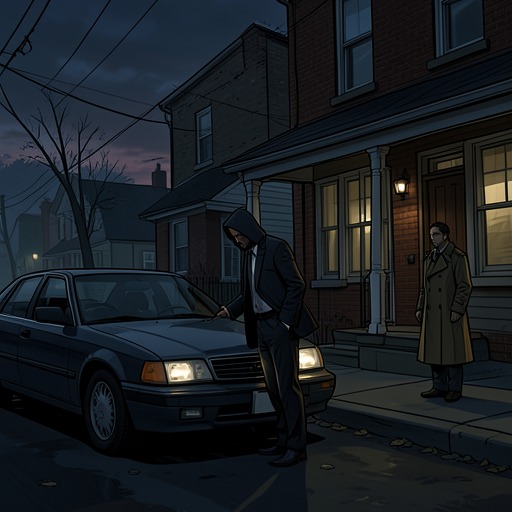
Sheeran said that after landing at the Pontiac airfield, he took a gray Ford left with its keys on the floor mat. He described it as a plain, dusty loaner rather than a conspicuous car, and suggested that vehicles could be borrowed from car lots without their owners knowing. He then followed directions from Russell Bufalino onto Telegraph Road, passed the Machus Red Fox Restaurant, turned onto Seven Mile Road, crossed a bridge over a small creek, and eventually reached the house by way of another bridge and a nearby footbridge. Although the route included several distinct turns and landmarks, Sheeran characterized it as simple and only a few miles long.
The house stood in a neighborhood where the homes were neither crowded together nor isolated. Sheeran recalled brown shingles, a high backyard fence, and a detached garage behind the house. He emphasized the contrast between that quiet domestic setting and Hoffa’s public appointment nearby: as Sheeran drove past the Machus Red Fox Restaurant, Hoffa was supposed to be waiting for him there for their 2:00 meeting. Sheeran said he was not worried that Hoffa would recognize him in the car, describing how his height and posture put his head close to the roof and made his face difficult to see from outside.
Sheeran described the house itself as another loaner, possibly borrowed while its owner was away. He speculated that someone in the Detroit organization might have learned through a chiropractor when a resident would be out of town, but presented this as a possibility rather than established knowledge. He also suggested that an elderly woman could have lived there alone and might not have noticed the brief use of her home. The speculation leaves the house’s actual ownership and the precise means of access unresolved in his account; what he asserted directly was that the house was still standing when he spoke about it.
Interior and Killing
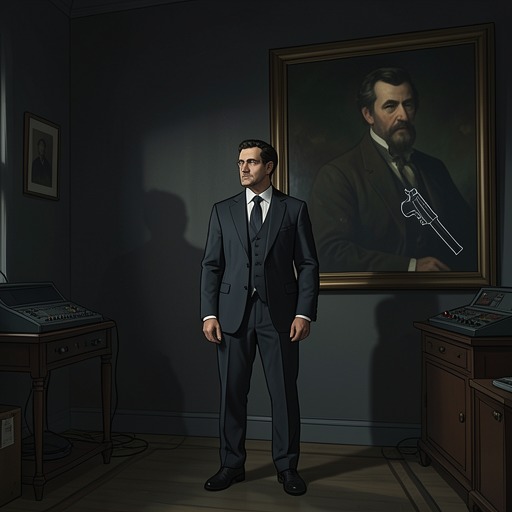
Sheeran’s account gives the house a practical interior geography. From the vestibule, a long hallway ran toward the kitchen at the back; a staircase rose on the left, while the living room and dining room opened on the right. The vestibule had a piece of linoleum rather than a rug, and the other rooms had rugs on the floor. Sheeran said the two young men in the kitchen were there to clean up, remove jewelry, and take Hoffa’s body away. He believed the rugs had probably been picked up where necessary, but did not know how the linoleum had come to be there. In this telling, even the floor coverings belonged to the operation’s preparation: surfaces could be cleared, replaced, and removed.
On the day of the meeting, Sheeran and Hoffa approached openly in daylight. The brown Buick and gray Ford still stood in the driveway, and Sheeran took their presence as a sign that the meeting remained on schedule; if either car had disappeared, he says, he would have understood that the plan was off. The ordinary scene offered no visible warning. Sheeran recalled that the house and neighborhood seemed suitable for raising children, and that no one required Hoffa to enter secretly through the detached garage. They walked to the front door and went inside.
According to Sheeran, the house was empty of anyone who might greet Hoffa. The two men assigned to clean were out of sight in the kitchen. Hoffa recognized what the empty rooms meant, Sheeran later claimed, and turned toward the door. Sheeran described himself as close behind Hoffa on the front stoop and in the vestibule. As Hoffa reached for the doorknob, Sheeran shot him twice in the back of the head, behind the right ear, from what he called a reasonable distance. He said the distance was chosen to avoid blood splatter reaching the shooter, and that Hoffa did not suffer. The house’s front entrance, initially a banal route into a meeting, became in Sheeran’s account the point where Hoffa understood the trap and tried to escape it.
Sheeran said he checked the hallway, listened for anyone approaching, dropped the gun on the linoleum, and left through the front door. He drove the Ford back to the Pontiac airfield, where Russell Bufalino’s pilot was waiting. His account assigns the subsequent handling of the body to the two cleaners, but that portion was not presented as something he witnessed: Sheeran said Russell Bufalino later told him that the men put Hoffa in a body bag, carried him out the back, and placed him in the Buick’s trunk before taking him to be cremated. Sheeran also relayed that they collected Salvatore Briguglio at Pete Vitale’s meatpacking plant and flew back to New Jersey. The distinction matters to the location’s story: Sheeran places the shooting inside the house as a firsthand confession, while the removal and disposal that followed reach the reader through what he said he had been told.
Identification and Evidentiary Status
The house became identifiable to readers through the process by which Sheeran’s account was recorded and tested, not through a police file that had conclusively resolved Hoffa’s disappearance. Charles Brandt first interviewed Sheeran in 1991, after his medical release from jail, but Sheeran ended that session when he reconsidered the questioning and what he had already disclosed. The interviews resumed after Sheeran’s 1999 meeting with a priest and continued for four years. Brandt brought experience as a homicide and death-penalty prosecutor and an interrogator; the exchange was persistent enough that Sheeran once told him he was worse than any policeman he had encountered.
About two years into the interviews, after Sheeran had admitted to Brandt that he was the shooter but before they went to Detroit to locate the house, Brandt arranged a meeting with Fox News correspondent Eric Shawn and producer Kendall Hagan. The plan was for Sheeran to tell someone besides Brandt, for the first time, that he had shot Hoffa. Two nights beforehand, Sheeran handed Brandt a typewritten letter purportedly signed by Hoffa in 1974; it mixed material consistent with Sheeran’s earlier account with details that could support a different, more fantastic version. Brandt said he would investigate its authenticity. At the meeting, Shawn asked whether Sheeran thought he could find the house. Sheeran supplied directions and mentioned the footbridge, a landmark he had not previously disclosed to Brandt. He then publicly stated that he had shot Hoffa twice in the back of the head. Fox News conducted preliminary independent research and confirmed the historical value of his account of Hoffa’s last ride; this did not, by itself, establish every detail of the killing or the house’s ownership.
Brandt describes the house’s identification as part of a longer, negotiated oral history. The book is based on one-on-one interviews, most tape-recorded, as well as Brandt’s trips with Sheeran to Detroit to locate the disappearance scene. During most of the questioning, Brandt sought to preserve Sheeran’s legal rights so that the statements would not constitute an admissible confession in court. Sheeran read and approved each chapter and then reread and approved the manuscript as a whole. Those stages document his continued endorsement of the account, while also making clear that the house’s role reaches the reader through a confession shaped by questioning, recollection, and later confirmation.
During his final illness, Sheeran agreed to appear on video and stand behind the book’s account, including what happened to Hoffa on July 30, 1975. Brandt asked whether the events in the book were things Sheeran had told him and whether he stood behind them; Sheeran answered yes to both. The camera battery failed and recording was interrupted, though Brandt reported that substantial audio and video material remained. The bedside affirmation gave the house a final place in Sheeran’s testimony: not merely the setting he had described, but the scene whose identification and meaning he continued to endorse near the end of his life.
Proximity and the Limits of the Account
Sheeran placed the house within a tightly compressed geography: it was only a few miles from where Hoffa’s remains would go, he said, and the journey from the house to the airfield was short. That proximity underpinned his rejection of accounts in which the body traveled much farther. He argued that no one handling such a high-profile killing would drive an unnecessary distance with a body in a car, much less transport it across the country in a barrel. In his version, the house was not simply where the shooting happened; it was one point in a deliberately compact route whose timing and distance were part of the plan.
He also used the house to distinguish his account from a theory that Hoffa had been killed inside Tony Jack’s son’s car. Sheeran argued that a car would retain the smell of death, while a house would not hold the odor in the same way. The contrast returns attention to the house’s domestic ordinariness: its rooms could be entered, cleaned, and left behind, while the confined interior of a car would betray what had happened. These explanations are Sheeran’s own reasoning, not independent proof of the killing or of the house’s use. The location’s evidentiary force therefore rests on the specificity of his route and interior description, alongside the limits of a claim preserved through interviews and his later endorsement.